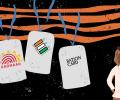
When the government chooses to either ignore or use identity documents only when it suits them, it shakes people's sense of stability, notes Shyam G Menon.

10 Heroes of the 1965 War which ended on September 23 60 years ago.
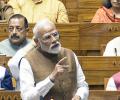
Prime Minister Narendra Modi defended India's actions against terrorism, stating no country stopped India and criticizing the Congress party for not supporting the armed forces. He highlighted the success of Operation Sindoor and warned Pakistan against further misadventures.

Asia Cup: India captain Suryakumar avoids shaking hands with Pak skipper Salman once again
When the government chooses to either ignore or use identity documents only when it suits them, it shakes people's sense of stability, notes Shyam G Menon.
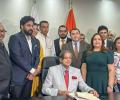
'Shashi Tharoor is destroying the history of India.' 'He is distorting facts about the Congress party.'

'However, we must implement a tit-for-tat approach -- reciprocating their conduct with precision.' 'If they demonstrate respect, we respond accordingly. If they adopt hostile positions, we mirror that hostility with equal intensity.'
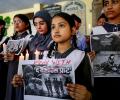
An Indian delegation met top officials of the United Nations Office of Counter-Terrorism (UNOCT) and Counter-Terrorism Committee Executive Directorate here even as New Delhi stepped up efforts to designate The Resistance Front, a Lashkar-e-Tayyaba proxy, as a UN-listed terror outfit for its alleged involvement in the Pahalgam attack.
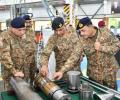
'If you fire two missiles at Jamnagar or ten missiles there, what do you think India will do?' 'India will fire 500 missiles on Tarbela and Mangla, destroy the Sukkur Barrage, destroy Karachi port.' 'When you start issuing threats, it should be with some sense and sensibility.' 'You shouldn't just shoot your mouth off just because you have appointed yourself field marshal.'

A Delhi court on Monday extended by 12 more days the NIA custody of 26/11 Mumbai attack accused Tahawwur Hussain Rana.

In a post on X, Sherman said that he 'emphasised to the Pakistani delegation the importance of combatting terrorism, and in particular, the group Jaish-e-Mohammed, who murdered my constituent Daniel Pearl in 2002'.
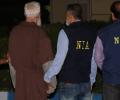
Tahawwur Hussain Rana, a Canadian national accused of involvement in the 2008 Mumbai terror attacks, has been extradited to India from the United States. Rana's interrogation is expected to shed light on the role of Pakistani state actors in the attacks, which claimed 166 lives. Indian authorities are particularly interested in his travels across India in the days leading up to the attacks, including visits to Hapur, Agra, Delhi, Kochi, Ahmedabad, and Mumbai. Rana's extradition follows a lengthy legal battle, with the US Supreme Court ultimately denying his application to challenge it. Rana is known to be associated with Pakistani-American terrorist David Coleman Headley, one of the main conspirators of the 26/11 attacks. The investigation into the Mumbai attacks has implicated senior members of terror outfits Lashkar-e-Taiba (LeT) and Harkat-ul Jihadi Islami (HuJI), as well as officials from Pakistan's Inter-Services Intelligence (ISI).
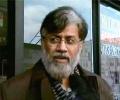
This was Rana's last legal chance not to be extradited to India. Earlier, he lost a legal battle in several federal courts, including the US Court of Appeals for the North Circuit in San Francisco.
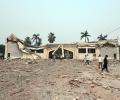
A former Pentagon official, Michael Rubin has said that India targeted terror infrastructure with precision, and it was able to blunt Pakistan's response following the recent strikes.
The hugely significant development comes just days after Rana's last-resort attempt to evade extradition to India failed after the US Supreme Court justices denied his application, moving him closer to being handed over to Indian authorities to face justice in the dastardly attacks.
According to the chargesheet, Rana played a crucial role in supporting terrorist David Coleman Headley, a Pakistani-American operative linked to Lashkar-e-Taiba, by facilitating his reconnaissance missions across Mumbai.
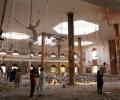
'But that was not our aim. Our objective was already achieved.'

'Shock, confusion, and paralysis reigned.' 'Pakistan was caught in a most embarrassing situation. It could neither claim credit for the operation nor admit to a dismal intelligence failure and lack of army preparedness.'

Pakistan fast bowler Haris Rauf has been fined 30 per cent of his match fees for abusive behaviour and making an aggressive gesture during the high-voltage Asia Cup clash against India, tournament sources confirmed.
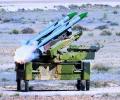
Military officials detail how the Indian Air Force's downing of a Pakistani aircraft at a long distance reflects its air superiority and dealt a psychological blow to the adversary.

The Border Security Force (BSF) launched "Operation Sindoor" in retaliation to unprovoked firing and shelling by Pakistani Rangers along the International Border (IB) in Jammu. BSF troops destroyed three terrorist launch pads and targeted 76 Pakistani border outposts and 42 forward defence locations. The BSF action came after Pakistan launched heavy firing and shelling on 60 Indian posts and 49 forward positions, reportedly providing cover for an attempted infiltration by 40-50 terrorists.

The Gujarat Anti-Terrorist Squad (ATS) has busted a terror module and arrested four individuals for allegedly promoting the ideology of Al-Qaeda in the Indian Subcontinent (AQIS). The arrests were made in a multi-state operation, with the accused involved in sharing radical content on social media to incite violence and establish 'sharia' law in India.

The Air Chief revealed information about India's damage to Pakistan's defence capabilities while addressing an event at the Hal Management Academy in Bengaluru on Saturday.

Chief Minister Omar Abdullah strongly criticized linking Jammu and Kashmir's political future to acts of terror, asserting that Pakistan cannot influence decisions on the region's statehood through terrorism. He announced a signature campaign to press for the restoration of statehood.
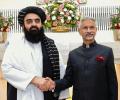
'Pakistan is uncomfortable with the Indian presence in Afghanistan. They want the Taliban to ensure that there is no Indian presence in Afghanistan.'

The Border Security Force (BSF) is training specialized 'drone commandos' and 'drone warriors' for modern warfare, with plans to deploy them in missions like Operation Sindoor. A 'School of Drone Warfare' has been inaugurated to provide training in UAV operations, anti-drone warfare, and surveillance.
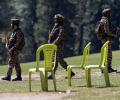
The officials said that intelligence agencies had been alerted about the possibility of a terror attack, but the inputs were utilised at another place, some 90 kilometres away from the site where the attack took place, resulting in a key security lapse.
'Operation Sindoor is still ongoing. The Prime Minister himself said that blood and water cannot flow together, that talks and terrorism cannot go together. So how can we have a cricket match with a country that indulges in terrorism?'

The Indian Army has released a booklet on Operation Sindoor, which was launched to avenge the April 22 ghastly Pahalgam attack in which Pakistan-backed terrorists brutally killed 26 civilians, mostly tourists, and left many injured.
Among the medal winners are a deputy commandant rank officer, two assistant commandants and an inspector.

The Indian Army shared a video of the brave canine on duty, doing what she was trained to do, lead soldiers in a search op drill.

Shaheen Shah Afridi steered clear of giving a direct response to Suryakumar Yadav's view that Indo-Pak games should not be considered a rivalry.

The President took the decisive move on May 27.

India and Pakistan agreed on May 10 for a cessation of firing and military activity as a result of 'direct contact' between the director generals of military operations (DGMOs) of both nations, which was 'initiated by the Pakistani side', the Centre informed Parliament on Friday.
"I'm very glad you raised this, Ishaan. I didn't plant it. I promise you. This guy does this to his dad," Tharoor replied amid laughter from the audience.
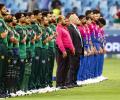
Pakistan withdrew its pullout threat and showed up for a crucial Asia Cup game against the UAE in Dubai on Wednesday but not before causing a delay.
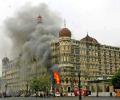
The senior IPS officer said Tata displayed resoluteness, uncharacteristic of his calm demeanour, when the iconic hotel came under attack.

Why India can't deny Pakistan entry to multi-lateral events on its soil
Union Home Minister Amit Shah said on Sunday that indigenously developed BrahMos missiles destroyed Pakistani air bases while its air defence system, borrowed from China, remained unused, during Operation Sindoor, which exposed its lies on terrorism to the world.

India's recent missile strikes on nine terrorist locations in Pakistan and Pakistan-occupied Kashmir (PoK), including Bahawalpur, mark a significant escalation in the long-standing military tensions between the two nations. This article provides a historical overview of the Indo-Pak military confrontations, tracing their roots back to the 1947 war following India's independence and the partition of the sub-continent, and highlighting key conflicts such as the 1965 war, the 1971 Bangladesh Liberation War, the 1999 Kargil War, the 2016 Uri attack, and the 2019 Pulwama attack.
